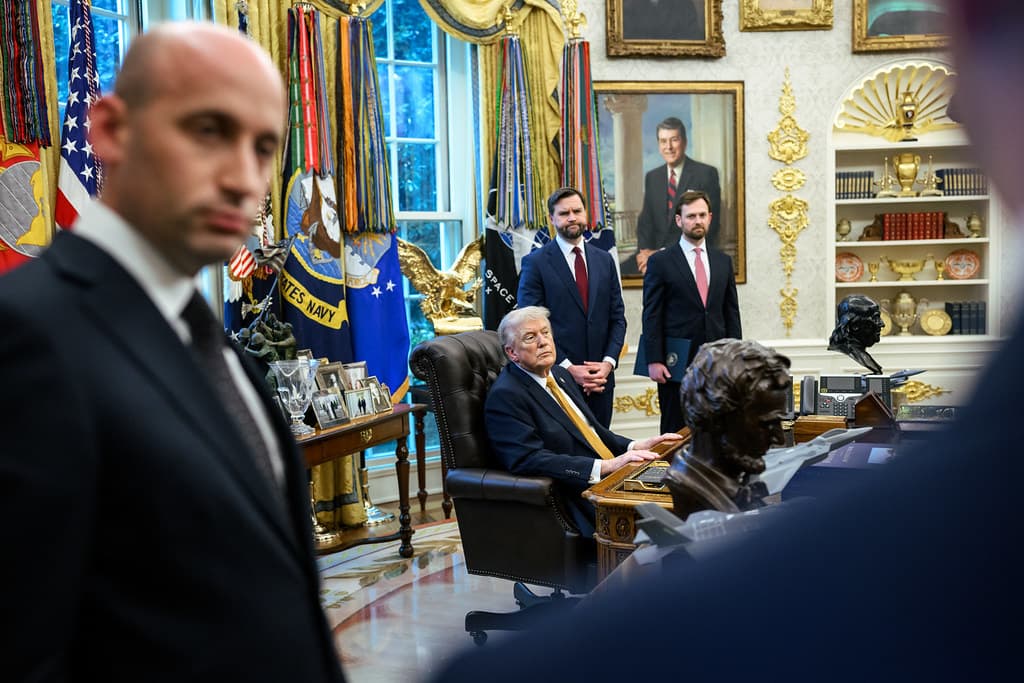
The House of Representatives rejected the Senate's stopgap funding bill for the Department of Homeland Security and prepared its own version. This legislative stalemate centers on border security provisions and spending levels. The standoff threatens a partial government shutdown affecting federal agencies responsible for national security, immigration, and travel. Markets showed immediate impact with increased risk aversion as the White House works to maintain essential services during congressional dysfunction. President Trump ordered that TSA employees be paid, bypassing the appropriations process. This move highlights the severity of the political impasse and its direct implications for the functioning of the American economy.
Markets reacted swiftly to the political drama, showing investor concern about the stability of federal operations. The S&P 500 dropped 0.8% in early trading, with the Dow Jones Industrial Average falling over 250 points. Travel and leisure stocks were hit hardest, with American Airlines (AAL) declining 2.1% and Marriott International (MAR) falling 1.7%. Yields on the benchmark 10-year U.S. Treasury note dropped 5 basis points to 4.25% as investors sought safety in sovereign debt. The crypto market also declined. Bitcoin (BTC) briefly retreated 1.5% to $68,500, while Ethereum (ETH) saw a 2.0% correction to $3,780, as broader market sentiment overshadowed immediate narratives of decentralization.
This current DHS funding dispute is the latest chapter in a ongoing congressional battle over federal spending and fiscal responsibility. The situation mirrors past government shutdowns, most notably the 35-day shutdown of 2018-2019, which cost the U.S. economy an estimated $11 billion. The dispute involves demands for increased border enforcement funding, potentially reaching $20 billion annually for new technologies and personnel, coupled with calls for significant cuts to other non-defense discretionary spending. This standoff reflects the deep ideological divide that continues to hamper effective governance, hindering the nation's ability to address pressing economic challenges and maintain regulatory predictability.
The current legislative dispute is largely driven by a faction of conservative House Republicans who are using the appropriations process to force concessions on border policy, demanding stricter immigration measures and a reduction in overall federal outlays. Speaker Mike Johnson faces pressure from this bloc with a narrow majority. This faction views robust border security as a non-negotiable priority, often citing the record 2.5 million migrant encounters at the southern border in fiscal year 2023. Opposing this stance are Senate Democrats and moderate Republicans, who advocate for a clean funding bill to prevent disruptions to essential services. The Biden administration, through figures like OMB Director Shalanda Young, has called for bipartisan cooperation to avert a shutdown, emphasizing the potential for economic damage and national security vulnerabilities.
A DHS shutdown would impact several key industries and critical infrastructure sectors beyond government offices. The travel and tourism industry is particularly vulnerable, with major airlines such as Delta (DAL), United (UAL), and Southwest (LUV) preparing for potential passenger processing delays at airports, which could lead to revenue losses estimated at $50-$100 million per week across the industry during past shutdowns. Companies holding federal contracts with DHS components like Customs and Border Protection (CBP) or the Cybersecurity and Infrastructure Security Agency (CISA), including defense contractors like Raytheon Technologies (RTX) and Palantir Technologies (PLTR), face payment delays and contract freezes, disrupting their operational cash flows. For the crypto industry, a prolonged shutdown could delay regulatory guidance from agencies like FinCEN, which falls under Treasury but often collaborates with DHS, creating further uncertainty for compliance and innovation, particularly concerning anti-money laundering frameworks and stablecoin oversight.
President Trump's directive to ensure TSA employees are paid without a formal appropriation creates a complex legal precedent challenging the traditional separation of powers regarding federal spending. While the Anti-Deficiency Act generally prohibits federal agencies from incurring obligations in advance of appropriations, the executive branch has historically invoked "essential services" exceptions during shutdowns. However, a direct order to pay furloughed employees without specific congressional authorization raises constitutional questions about presidential authority and could invite legal challenges regarding the integrity of the appropriations process. For regulated industries, including financial services and crypto, a partial shutdown creates immediate enforcement implications. Federal agencies like the SEC, CFTC, and FinCEN often operate with reduced staff during such periods, potentially delaying investigations, enforcement actions, and the issuance of regulatory clarity, thereby increasing compliance costs for firms in an already complex environment.
The immediate focus shifts to the House vote on its revised stopgap measure, which will determine if a full or partial DHS shutdown can be averted temporarily. Should this bill pass the House, its fate in the Senate remains highly uncertain, setting the stage for continued political conflict and potentially a more prolonged funding lapse. This recurring fiscal instability affects the broader legislative agenda, particularly for sectors like digital assets. Bills aimed at establishing regulatory frameworks for stablecoins and defining market structures for crypto assets, which have seen slow progress in committees, are likely to be further delayed as congressional attention is consumed by basic appropriations. The failure to secure fundamental government funding signals a deeper systemic issue that will continue to impede progress on complex, forward-looking policy initiatives.
This political standoff, where the functioning of essential government services becomes a bargaining chip, harms America's economic stability and global leadership. The DHS funding standoff affects predictable governance, a foundational requirement for any thriving market, especially for sectors like crypto. When agencies like FinCEN or the SEC face operational uncertainty, it directly impacts the timelines for regulatory clarity that the industry needs to mature and scale. Billions in potential investment capital are affected by D.C. conflicts. This creates a structural impediment. Until Congress prioritizes stable, responsible governance over partisan disputes, the U.S. risks losing its competitive edge, leaving innovators and investors in a perpetual state of uncertainty.


