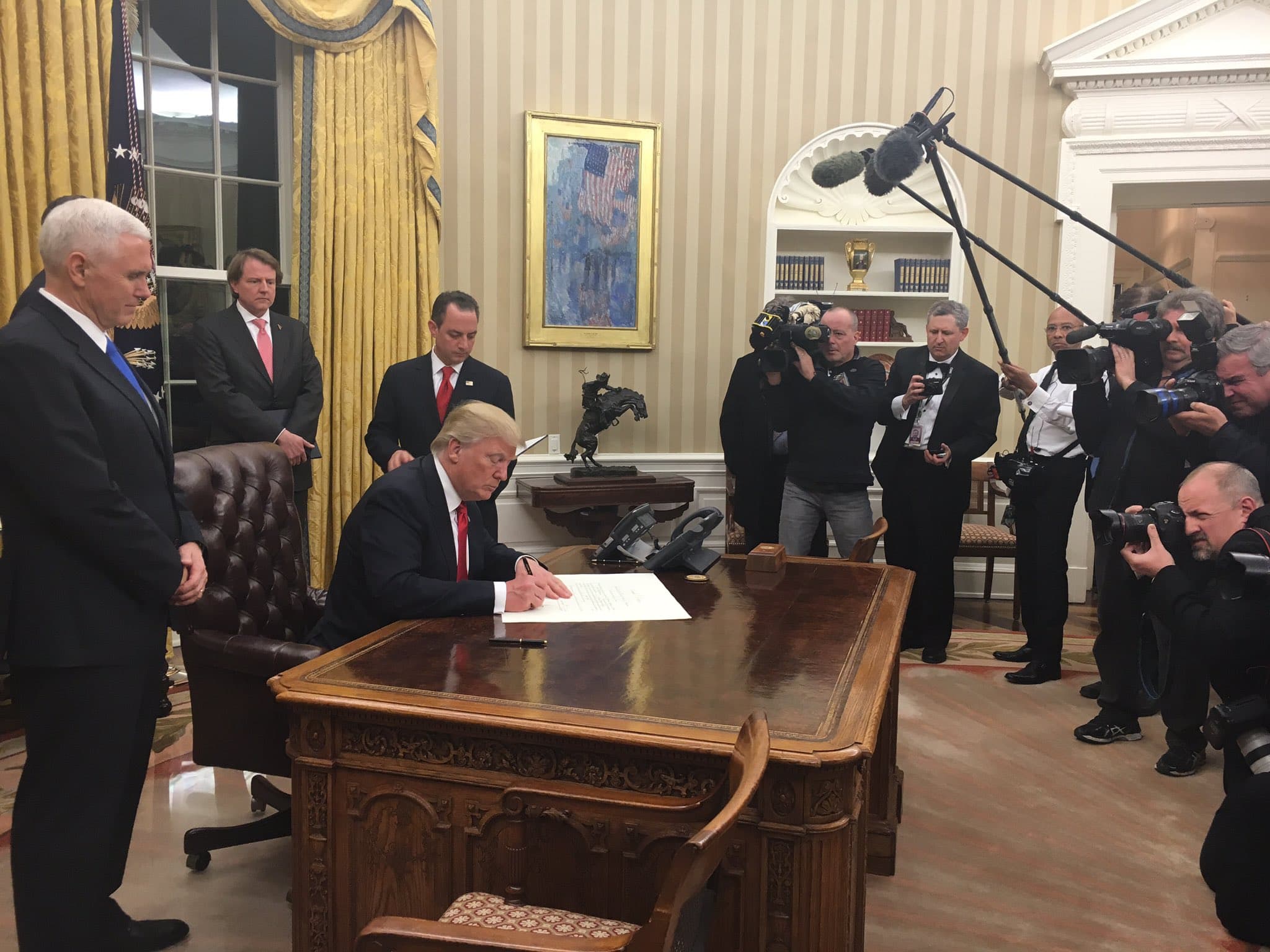
WASHINGTON — President Trump met with a delegation of Muslim leaders today, discussing a framework for a peace deal with Israel to be implemented following any future conflict with Iran. The president outlined a vision for regional stability, linking it directly to economic opportunity and foreign investment.
The proposal suggests massive reconstruction and infrastructure projects across the Gulf and potentially Iran itself, once hostilities cease. Defense contractors like Lockheed Martin, which reported $67.6 billion in net sales for 2025, and Raytheon Technologies are positioned for initial security and stabilization contracts. Engineering and construction giants such as Bechtel and Fluor Corporation are eyeing large-scale rebuilding efforts, potentially worth hundreds of billions over the next decade. These companies have already begun informal lobbying efforts in Washington for favorable contract terms.
Gulf states, particularly Saudi Arabia and the United Arab Emirates, would be central to financing these ventures. Their sovereign wealth funds, including Saudi Arabia's Public Investment Fund with over $900 billion in assets, would funnel capital into projects designed to stabilize the region, secure new trade routes and develop energy infrastructure. This would strengthen economic ties with Washington, consolidating U.S. influence against rival powers like China and Russia, which have also sought to expand their footprint in the region.
The diplomatic initiative also carries major implications for global energy markets. While immediate conflict fears would spike crude prices, a structured post-war peace and reconstruction plan could stabilize energy supplies and investment in new production capabilities. A barrel of Brent crude currently trades at $88.50, up 0.7 percent on the day, reflecting ongoing geopolitical uncertainty and the potential for long-term supply shifts. Companies like ExxonMobil and Chevron would seek to secure new exploration and development rights in a stabilized region.
This move puts pressure on European and Asian firms hoping to secure reconstruction contracts. U.S. officials indicated preferential treatment for American companies, using political capital earned through military involvement and diplomatic leadership. The White House has held preliminary discussions with the U.S. Export-Import Bank about potential financing guarantees for American firms.